Sooner Politics.org
  • Front Page
  • Oklahoma News
    • Weather
    • Oklahoma Watch
    • OKCtalk
    • Oklahoma Constitution News
    • Oklahoma History
    • Today, In History
    • Faked Out Sports
    • Lawton Rocks
    • OSU Sports
  • Podcasts
    • Fresh Black Coffee, with Eddie Huff
    • AircraftSparky
    • Red River TV
    • Oklahoma TV
    • E PLURIBUS OTAP
    • Tapp's Common Sense
  • Editorial
    • From the Editor
    • Weekend Report
  • Sooner Issues
    • Corruption Chronicle
  • Sooner Analysts
    • OCPA
    • Muskogee Politico
    • Patrick McGuigan
    • Eddie Huff & Friends
    • 1889 Institute
    • Steve Byas
    • Michael Bates
    • Steve Fair
    • Josh Lewis
    • Jason Murphey
    • AFP Oklahoma
    • Sooner Tea Party
  • Nation
    • Breitbart News
    • Steven Crowder
    • InfoWars News
    • Jeff Davis
    • The F1rst
    • Emerald
    • Just the News
    • National Commentary
  • Wit & Whimsy
    • Libs of Tiktok
    • It's Still The Law
    • Terrence Williams
    • Will Rogers Said
    • Steeple Chasers
    • The Partisan
    • Satire
  • SoonerPolitics.org

Osage-Cherokee War

1/31/2023

0 Comments


Osage-Cherokee War - The arrival of white-dominated American civilization did not inaugurate encroachment upon and conquering of Native lands in the American Southwest—or elsewhere…

Read the full story at John Dwyer’s

The Oklahomans

https://www.johnjdwyer.com/post/osage


Read the entire Oklahoma story in John J. Dwyer's Media

The Oklahomans: The Story of Oklahoma and Its People
volume 1 of a 2-part series on the 46th state and the people who make this state very special.
0 Comments

Edwin James - Botanist

1/30/2023

0 Comments


“Present-day Oklahoma and the American Southwest were providentially placed to keep the American people from ruinous diffusion… We have little apprehension of giving too unfavorable an account of this portion of the country. Though the soil is in some places fertile, the want of timber, of navigable streams, and of water for the necessities of life, render it an unfit residence for any but a nomad population. The traveler who shall at any time have traversed its desolate sands, will, we think, join us in the wish that this region may forever remain the unmolested haunt of the native hunter, the bison, and the jackall.”

 -Edwin James, botanist accompanying American explorer Stephen H. Long

 With his own eyes James witnessed scenes ranging from bald eagles to pelicans to wild horses to a square-mile-large prairie dog colony. As recounted in W. David Baird and Danny Goble’s The Story of Oklahoma, he also wrote of the constant bedeviling presence of seed ticks in the lives of Oklahoma explorers:

“The bite is not felt until the insect has had time to bury the whole of his beak, and in the case of the minute and most troublesome species, nearly his whole body seems hid under the skin. Where he fastens himself with such tenacity… he will sooner suffer his head and body to be dragged apart than relinquish his hold.”

Read the entire Oklahoma story in John J. Dwyer’s
The Oklahomans: The Story of Oklahoma and Its People
volume 1 of a 2-part series on the 46th state and the people who make this state very special.


Read the entire Oklahoma story in John J. Dwyer's Media

The Oklahomans: The Story of Oklahoma and Its People
volume 1 of a 2-part series on the 46th state and the people who make this state very special.
0 Comments

Exploring Farther

1/29/2023

0 Comments


Stephen Harriman Long, early American explorer of present-day Oklahoma.

Stephen Long Explores Oklahoma Region

Neither cold nor heat, drought nor flood, dangerous Indians nor hostile Spaniards could stem the surge of American merchants, scientists, adventurers, missionaries, and soldiers who persevered across the rivers, then the lands of present-day Oklahoma. While the imperial powers of Europe drained each other’s blood and treasure, or sank into non-productive lassitude, the young American nation born of them vibrated with energy and ambition. Indeed, many people would have many ideas for Indian Territory.
Scores of daring American entrepreneurs yearned to reach the bountiful trading hub of Santa Fe to the west of Texas, but well-armed Spanish troops under orders from their distant government prevented that, at the point of the bayonet when necessary. It was no place for the faint of heart or the uncertain of aim. Many of the keenest observations and most notable discoveries by Americans were accomplished by private citizens such as scientists or merchants, rather than those in government service.
One of the most intrepid American explorers of early Oklahoma, though, was U.S. Army Engineer Stephen Long. As the Osage-Cherokee war raged in 1817, the War Department commissioned him to choose a location on the Arkansas River for a fort to help calm that vicious feud, as well as to protect the American settlers beginning to enter the area. Long established Fort Smith, later one of the largest cities in Arkansas.
Then, encouraged by the Adams-Onis Treaty signed between the United States and Spain, a series of important American explorations trekked through present-day Oklahoma in the late 1810s and early 1820s. Natural and manmade dangers alike lurked in every direction throughout the rough country.
Long’s Epic Journey Two years after his first Oklahoma adventure, esteeming his toughness and coolness of mind in dangerous situations, the War Department sent Long west on an even more daunting mission: finding the elusive headwaters of the Arkansas and Red Rivers. Numerous previous American expeditions had failed to do so. Also plagued throughout the expedition by supply shortages due to the financial Panic of 1819, Long trekked across the Great Plains to the Rocky Mountains, then in the summer of 1820 detached Captain John H. Bell and a dozen men to follow the Arkansas back to Fort Smith.
This group, which included the father of American zoology, Thomas Say, faced its own desperate odyssey, braving thirst and scorching heat before reaching their destination. Say suffered additional heartache as deserting soldiers stole five journals in which he had painstakingly compiled vast amounts of eyewitness data about newly christened Indian Territory’s people, plants, animals, geography, and minerals. Forging on from memory and the remnants of his expedition writings, he managed to publish a book chronicling the Bell expedition.

Stephen Long’s great 1820 expedition through present-day Oklahoma continued his preceding year’s exploration of the Missouri River. The remarkable pathfinder seemed to find a way to answer every one of the many formidable challenges that arose with ingenuity and resourcefulness.

Read the entire Oklahoma story in John J. Dwyer’s
The Oklahomans: The Story of Oklahoma and Its People
volume 1 of a 2-part series on the 46th state and the people who make this state very special.


Read the entire Oklahoma story in John J. Dwyer's Media

The Oklahomans: The Story of Oklahoma and Its People
volume 1 of a 2-part series on the 46th state and the people who make this state very special.
0 Comments

Scientist Describes the Cherokees

1/28/2023

0 Comments


Scientist Describes the Cherokees

 Among the lasting scientific and historic contributions of famed American botanist Thomas Nuttall during his trip to Oklahoma in 1819 is his description of the sophisticated and advanced Cherokees he met as he traveled the Arkansas River:
Both banks of the river, as we proceeded, were lined with the houses and farms of the Cherokee, and though their dress was a mixture of indigenous and European taste, yet in their houses, which are decently furnished, and in their farms, which were well fenced and stocked with cattle, we perceive a happy approach toward civilization. Their numerous families, also, well fed and clothed, argue a propitious progress in their population. Their superior industry either as hunters or farmers proves the value of property among them, and they are no longer strangers to avarice and the distinctions created by wealth. Some of them are possessed of property to the amount of many thousands of dollars, have houses handsomely and conveniently furnished, and their tables spread with our dainties and luxuries.

Read the entire Oklahoma story in John J. Dwyer’s
The Oklahomans: The Story of Oklahoma and Its People
volume 1 of a 2-part series on the 46th state and the people who make this state very special.


Read the entire Oklahoma story in John J. Dwyer's Media

The Oklahomans: The Story of Oklahoma and Its People
volume 1 of a 2-part series on the 46th state and the people who make this state very special.
0 Comments

Plains Tribes

1/27/2023

0 Comments


Plains Tribes

 Though perhaps not all of it lay in the “Great American Desert" invoked by contemporary American explorers and maps, the western half of early eighteenth-century present-day Oklahoma still hosted few people. Most numerous were likely the aforementioned nomadic bands of Comanches and Kiowas who had migrated from the west over the previous few decades. Though their impact on the region would grow through the 1800s, already they occasionally clashed with the Osages, Apaches, and others.
Meanwhile, the Wichitas’ long dismal retreat from the Osages southward toward Texas continued.
Modern-day place names such as their large namesake city in southern Kansas, the Wichita Mountains near Lawton in southwest Oklahoma, and the city of Wichita Falls across Red River in north Texas indicate the tribes’ path.

George Catlin’s early-1830s depiction of a Comanche Village, Women Dressing Robes and Drying Meat as they no doubt would have appeared just a few years before as well, in the 1820s.

Read the entire Oklahoma story in John J. Dwyer’s
The Oklahomans: The Story of Oklahoma and Its People
volume 1 of a 2-part series on the 46th state and the people who make this state very special.


Read the entire Oklahoma story in John J. Dwyer's Media

The Oklahomans: The Story of Oklahoma and Its People
volume 1 of a 2-part series on the 46th state and the people who make this state very special.
0 Comments

The Chickasaws

1/26/2023

0 Comments


The Chickasaws 

The power of this tribe, too, far exceeded its small numbers. The Chickasaws included at most forty-five hundred men, women, and children during the time of their southeastern residence and interaction with Europeans and white and black Americans. Like the Choctaws, Creeks, and Seminoles, the Chickasaws spoke a Muskhogean language. Their homeland included western Kentucky and Tennessee, northern Mississippi, and northwestern Alabama.

The Chickasaws were at least as closely related to the Choctaws as the Seminoles were to the Creeks. The Chickasaws and Choctaws formed a single tribe until sometime prior to Spaniard Hernando DeSoto’s 1540 discovery of them. The tribe’s very name probably means “they left as a tribe not a very great while ago.“ But the Chickasaws possessed a much keener commitment to the art of war than the Choctaws, and they were feared by the latter (despite the Choctaws’ numerical superiority), other tribes in their region, and even eventually Europe’s most powerful nations.

As Britain and France competed for control of North America-and in particular the lower Mississippi River and Valley and the Gulf ports to the south-in the early 1700s, the French cultivated the Choctaws as native allies, and the British did the same with the Chickasaws. So troublesome did the Chickasaws become to French efforts in the region, their governor of Louisiana declared in 1735 that the tribe’s “entire destruction … becomes every day more necessary to our interests and I am going to exert all diligence to accomplish it.”

From 1720 to 1763 several French armies marched into Chickasaw country from southern Louisiana and Mississippi to conquer the tribe. Choctaws, white militia, and black slaves supported the armies. All these efforts failed, and the tribe remained unvanquished when France surrendered its claims on the continent to the victorious British after losing the Seven Years War-including its North American theater, the French and Indian War-to them.

Horatio Cushman in his 1899 chronicle History of the Choctaw, Chickasaw, and Natchez Indians, noted how, contrary to the Chickasaws’ long conflict with the French European powers, “neither the Choctaws nor Chickasaws ever engaged in war against the American people, but always stood as their faithful allies.’

Read the entire Oklahoma story in John J. Dwyer’s
The Oklahomans: The Story of Oklahoma and Its People
volume 1 of a 2-part series on the 46th state and the people who make this state very special.


Read the entire Oklahoma story in John J. Dwyer's Media

The Oklahomans: The Story of Oklahoma and Its People
volume 1 of a 2-part series on the 46th state and the people who make this state very special.
0 Comments

The Seminoles

1/25/2023

0 Comments


The Seminoles

This tribe originated in the early 1700s from Yamasee and Lower Creeks who migrated into northern and central Spanish Florida following their defeat by the South Carolinians in the Yamasee War. Military confrontations with white settlers as well as dwindling game for food perpetuated this exodus throughout the eighteenth century. The emigrants grew increasingly autonomous from the Lower Creeks. Gradually, they took on the name “Seminole,” meaning “wild” “runaways,” or “separatists,” which reflected their watershed departure.

Later in the 1700s, the Seminoles welcomed black slaves escaping Spanish masters into their company. Though apparently retaining their servile status, these descendants of Africa lived in communities near the Seminole villages, grew into a significant component of the tribe, and received treatment as virtual equals. Following the American defeat of the Creeks at Horseshoe Bend, more Creeks headed to Florida to join the Seminoles. This time, Upper-not LowerCreeks, pro-British “Red Stick” veterans of the War of 1812, comprised the majority of the migrants.

The war refugees ballooned the Seminole population from thirty-five hundred to six thousand. By 1815 these disparate companies comprised a formidable though still small nation. Their resistance to removal from their Florida homelands, however, casts a large legacy in American history books. Hunting on lands in that state as well as southern Georgia and Alabama, they centered their communities in Florida and lived as town-dwellers. Unlike the other southeastern tribes, they eschewed farming.

The Seminoles’ initial significant conflict as a tribe with the United States occurred in 1817 to 1818 with the first of a series of “Seminole Wars.” White Georgian slave owners, whose major (and Constitutionally protected) financial capital in the economic system of the time consisted of their black slaves, complained to the U.S. government about runaways among these folk living with the Seminoles. General Andrew Jackson, in the latest of a long series of battles (violent as well as non-violent) with Natives, led an American army into Florida to retrieve the escapees, burning down a Seminole town in the process.

As they did in many other places, from the time the United States purchased Florida from Spain in 1819, American settlers began swarming onto the tribe’s land, settling it, and then urging the U.S. government to remove the resident tribes. In 1823 the powers in Washington gained the Seminoles’ agreement to the Treaty of Tampa, which required the tribe’s move south to the swampy inland Everglades region east of Tampa.

Even this did not work, because the Indians accused whites of harassment and the whites accused the Seminoles of theft, property destruction, and violence. The whites demanded the tribe’s relocation to Indian Territory. The Seminoles’ toughness, geography, history, leadership, and sense of place and other cultural traditions would generate a less than cordial response from them toward federal soldiers’ efforts to force them west.

An early 1800s Seminole village in Florida, prior to the tribe’s wars with the United States and the exile of most of them to Indian Territory.

Read the entire Oklahoma story in John J. Dwyer’s
The Oklahomans: The Story of Oklahoma and Its People
volume 1 of a 2-part series on the 46th state and the people who make this state very special.


Read the entire Oklahoma story in John J. Dwyer's Media

The Oklahomans: The Story of Oklahoma and Its People
volume 1 of a 2-part series on the 46th state and the people who make this state very special.
0 Comments

The Choctaws

1/24/2023

0 Comments


The Choctaws

Probably the most populous tribe on the entire continent in the nineteenth century, the talented and powerful Choctaws excelled as farmers, hunters, and diplomats alike. Like some other southeastern tribes such as the Cherokees, the Choctaws increasingly adapted the practices and institutions of Western Christendom, partly to forestall their removal from their ancestral homelands. Around twenty-two thousand Choctaws spread from the middle of the Mississippi River Valley southward to the Gulf of Mexico at the beginning of the 1800s. They traded and conversed effectively with the European powers who frequented the Gulf ports of the area.

The Choctaws organized their country into three regions, each governed by a principal chief, similar to a nation’s president. One chief, Pushmataha, gained renown as a statesman, commercial visionary, and warrior. As shrewd and eloquent as he was rugged and brave, he proved to be the match of American leaders such as James Monroe, Andrew Jackson, and John Calhoun, as well as other tribal leaders such as the Shawnee Tecumseh. He sparred with all of them over matters of supreme importance to both the Choctaws and the United States. A national Choctaw council composed of other leaders from throughout the tribe, similar to a Congress, also carried authority.

The Choctaws-notably Pushmataha-demonstrated their hunting prowess and physical vigor with journeys as far west as present-day Oklahoma, hundreds of miles from their Mississippi homeland. Two developments winnowed out the game population of the Gulf States and forced these long and dangerous treks. One was the multiplying American population in the South, the other the burgeoning fur trade with Europe. In present-day Oklahoma, the Choctaw hunters not only slew great hauls of game, they clashed with Osages, Caddos, and other tribes residing in the area, as well as American merchants who traded with them.

Like the other southeastern “civilized” tribes, the Choctaw advances in Western culture failed to prevent growing pressure from the American people and their government for the tribe’s removal to the west. To the Natives’ surprise, they would face new chapters of oppression even after they made those treks.

PushmatahaFather of the Choctaws (c. 1764-1824) “A little cloud was once seen in the northern sky. It came before a rushing wind, and covered the Choctaw country with darkness. Out of it flew an angry fire. It struck a large oak, and scattered its limbs and its trunk all along the ground, and from that spot sprung forth a warrior fully armed for war. And that man was Pushmataha.”

Read the entire Oklahoma story in John J. Dwyer’s
The Oklahomans: The Story of Oklahoma and Its People
volume 1 of a 2-part series on the 46th state and the people who make this state very special.


Read the entire Oklahoma story in John J. Dwyer's Media

The Oklahomans: The Story of Oklahoma and Its People
volume 1 of a 2-part series on the 46th state and the people who make this state very special.
0 Comments

Creek Civil War

1/23/2023

0 Comments


Centered by the 1810s in the Alabama River Valley, the Upper Creeks were led by the determined Opothleyahola. Though not engulfed in the Yamasee War of a century before, they held conservative, traditionalist beliefs with little interest in assimilating into American culture or embracing American institutions. To the east in Georgia along the Chattahoochee, Ocmulgee, and Flint Rivers, lived the Lower Creeks, who had their own strong leader, William McIntosh. Ironically, though desperate foes of the English and proto-Americans in the Yamasee War, they now possessed a more “progressive" philosophy and favored adoption of most American ways, including education, commerce, technology, and the Christian faith.The philosophical divide between the Upper and Lower Creeks exploded into violent civil war in the Red Stick War (1813-14).

Influenced by the great Shawnee chief and war captain Tecumseh, Opothleyahola simultaneously led the Upper Creeks (Red Sticks, for their red war clubs and their shamans’ supposed magical red sticks) into a disastrous alliance with the British during America’s second war with Britain, the War of 1812. The Lower Creeks, meanwhile, sided with the American colonists. This conflict, incited by atrocities such as the Upper Creek massacre of nearly 250 white settlers and Lower Creek men, women, and children at Fort Mims, near Mobile, Alabama, culminated in the Upper Creeks’ bloody defeat at the Battle of Horseshoe Bend in 1814. The victorious American forces in that famous fight included General and future President Andrew Jackson, future “Father of Texas” Sam Houston, the Cherokees, the Choctaws, and most of the Lower Creeks.

After their landmark pummeling at Horseshoe Bend, the Upper Creeks retreated to a more subtle rejection of American ways. But their anger and bitterness at those—and the Lower Creeks support of them-simmered, to flash into bloodshed again later. The United States government The Creeks voted in a death did more

penalty for any tribesman than simmer. who attempted to sell Creek They forced land to white settlers. the Creeks to cede twenty-two million acres of land in Alabama and Georgia and then pressured them to move west.

All this triggered long-term as well as shortterm consequences for the tribe. It turned the majority of Creeks so strongly against further land cessions, including an exchange for lands out west, that they determined to give up no more land to the Americans. They also voted in a death penalty for any tribesman who attempted to sell Creek land to white settlers. Sadly, opinions on the land issue were not unanimous within the tribe.

“Red Stick” Upper Creeks massacring white settlers, Lower Creeks, and militia in 1813 at Fort Mims, near Mobile, Alabama. Such bloodshed led to the Upper Creeks’ crushing defeat by the U. S. and its Indian allies at the Battle of Horseshoe Bend in 1814 

Read the entire Oklahoma story in John J. Dwyer’s
The Oklahomans: The Story of Oklahoma and Its People
volume 1 of a 2-part series on the 46th state and the people who make this state very special.


Read the entire Oklahoma story in John J. Dwyer's Media

The Oklahomans: The Story of Oklahoma and Its People
volume 1 of a 2-part series on the 46th state and the people who make this state very special.
0 Comments

The Creeks

1/22/2023

0 Comments


The Creeks 

The Cherokees were not the only tribe pressured into moving to the Southwest. To their west and south lay over twenty thousand members of the Muscogee Confederation of tribes. The powerful Creeks comprised the vast majority of this people, along with smaller numbers of Natchez, Alabamas, Koasatis, and Euchees. Historian Gaston Little recounted the fearsome reputation of the Creeks:

“The Creek men were tall and slender and their women were well-formed and beautiful. Bravery was a characteristic among the Creeks, whose warriors defeated in battle all the surrounding tribes. The Creeks were considered during colonial times to be the most powerful of the southern tribes”.

The Creeks and their related tribes lived across wide expanses of Alabama and southern Georgia. In addition to their martial vigor, they were accomplished farmers and possessed a sophisticated system of governance. On local matters the latter consisted of leaders who each governed a town. A two-house legislative body, meanwhile, governed the nation.

Big trouble loomed, however, both from within and without for the Creeks. Two major factions—the Upper Creeks and Lower Creeks, first so referenced by the English-comprised the Creek Confederation. These names evolved from the brutal Yamasee War of 1715 to 1717 in which the Creeks, Choctaws, and other Southeastern tribes fought a war of extermination with colonial South Carolina, seeking to expel the English from the region. Many of these Indians had earlier conspired with the English in an unholy slave trade involving Indians from weaker tribes. The tainted parties fell out with one another as the colonists grew stronger and wealthier and their Indian collaborators grew increasingly indebted to them. As described by anthropologist Jack M. Schultz, war ensued after English traders also began to enslave their Indian allies and families as payment for their debts.

During the Yamasee War, the Upper Creeks lived mainly to the west of the Chattahoochee River in present-day Alabama and refrained from fighting the Carolinians. The Lower Creeks lived along and to the east of the Chattahoochee and, along with the Yamasees, spearheaded the Indian effort. (Though appearing on maps west and east, respectively, the colonial perspective of the era, with communities narrowly strung along the Atlantic Coast, looked outward to the west from the east. Thus, the more remote western environs then appeared higher, or upper, on maps and the nearer regions lower.)

Creeks in a pre-removal Georgia village. Extended families or clans lived in clusters of cabins or teepees

Read the entire Oklahoma story in John J. Dwyer’s
The Oklahomans: The Story of Oklahoma and Its People
volume 1 of a 2-part series on the 46th state and the people who make this state very special.


Read the entire Oklahoma story in John J. Dwyer's Media

The Oklahomans: The Story of Oklahoma and Its People
volume 1 of a 2-part series on the 46th state and the people who make this state very special.
0 Comments
<<Previous
    Picture
    author John J Dwyer

    John Dwyer's   Oklahoma History

    Author John Dwyer takes us on a voyage through time, to discover Oklahoma is ways we've never fully understood.
    Picture
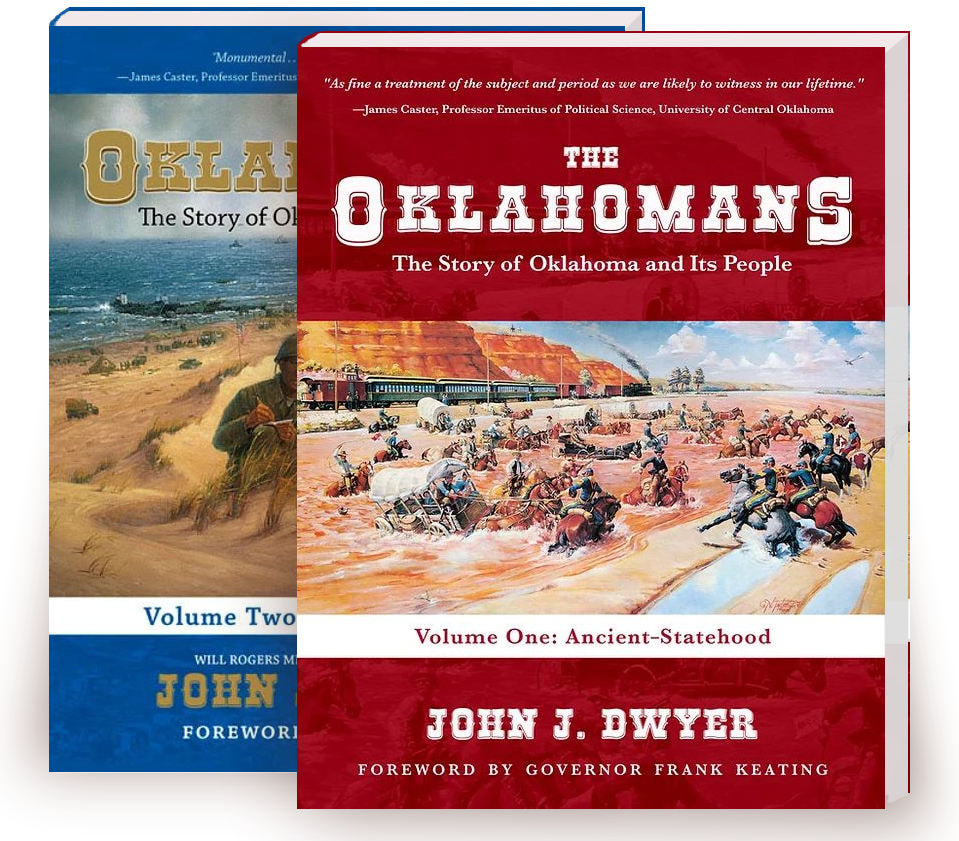
     The hardbound pictorial of volume 1 is available for a limited time at up to 40% off, using this link.

    Archives

    February 2025
    December 2024
    August 2024
    July 2024
    May 2024
    March 2024
    February 2024
    January 2024
    December 2023
    October 2023
    September 2023
    August 2023
    July 2023
    June 2023
    May 2023
    April 2023
    March 2023
    February 2023
    January 2023
    December 2022
    November 2022
    October 2022
    September 2022
    August 2022
    July 2022
    June 2022
    July 2021
    June 2021

      Novelist and Oklahoma native Ralph Ellison said, "You have to leave home to find home", an apt description of the journey of John Dwyer, author and general editor of The Oklahomans. The Dwyer family roots were firmly transplanted from Ireland to Oklahoma by John's great-grandfather and grandfather, the latter who settled in Oklahoma City in 1909, just two years after Oklahoma achieved statehood. Although born in Dallas, TX, John was relocated to Oklahoma when his widowed mother returned to her home when he was two years old.
      It would be on Oklahoma soil that his mother instilled in him his love for history, and coupled with his unusually creative imagination, it soon became apparent that John not only liked to hear great stories of legend and history, but to make up his own as well. It would be out of a sense of divine purpose that he would use that creativity in response to a higher calling in the years to come.
      John began a career in journalism during his high school days when he served in a variety of roles, including news and sports reporter, for the Duncan Banner, a daily newspaper in his small Oklahoma hometown. He was the youngest sports editor in the newspaper's history by the time he attended the University of Oklahoma on a journalism scholarship. He graduated in 1978 with a bachelor of arts and sciences degree in journalism.
      Dwyer further developed his journalistic skills in radio as a play‐by‐play football and basketball announcer for several radio stations. He won the coveted position of sports director for the University of Oklahoma's 100,000 watt KGOU‐FM radio station. For seven years, he provided live, on‐air reports to America's largest radio networks of University of Oklahoma college football games.
      Except for a year in England during 6th grade, John lived in the Sooner State for 28 years before returning to Dallas in 1986 to attend Dallas Theological Seminary where he earned his Master of Biblical Studies. While there, Dwyer worked part time on the sports staff of The Dallas Times Herald, which at the time owned one of the five largest circulations of any daily newspaper in Texas. It was in Texas that he also met and married his wife Grace in 1988 and settled down to start his family.
      In the spring of 1992, Dwyer and his wife founded the Dallas‐Fort Worth Heritage newspaper, which would grow to a circulation of 50,000 per month at the time of its sale, after nearly a decade, to new owners. The Heritage pioneered innovative features such as full color photography and graphics, an expansive web site, a cluster of informative daily radio programs, and an aggressive, uncompromising brand of investigative news reporting unprecedented for contemporary news publications holding an
    orthodox Christian worldview.
      In 2006, at the urging of his family and the Oklahoma Historical Society, John returned to Oklahoma to tackle the colossal task of writing "The Oklahomans," which was endorsed as an official project of the Oklahoma Centennial Commission. He has completed volume 1 (Ancient‐Statehood) and a portion of volume 2 (Statehood‐Present), which releases in November 2018.
      He is now an Adjunct Professor of History and Ethics at Southern Nazarene University. He is former history chair at Coram Deo Academy, near Dallas, Texas. His books include the non‐fiction historical narrative "The War Between the States: America's Uncivil War" (Western Conservatory), the novel "When the Bluebonnets Come" (Bluebonnet Press), the historical novels "Stonewall" and "Robert E. Lee" (Broadman & Holman Publishers), and the upcoming historical novels "Shortgrass" and "Mustang" (Oghma Creative Media).
      John and Grace have one daughter and one grandson and live in Norman, Oklahoma. They are members of the First Baptist  Church of Norman, where they serve in a variety of teaching, mission, and other ministry roles.

    Categories

    All

    RSS Feed

Powered by Create your own unique website with customizable templates.
  • Front Page
  • Oklahoma News
    • Weather
    • Oklahoma Watch
    • OKCtalk
    • Oklahoma Constitution News
    • Oklahoma History
    • Today, In History
    • Faked Out Sports
    • Lawton Rocks
    • OSU Sports
  • Podcasts
    • Fresh Black Coffee, with Eddie Huff
    • AircraftSparky
    • Red River TV
    • Oklahoma TV
    • E PLURIBUS OTAP
    • Tapp's Common Sense
  • Editorial
    • From the Editor
    • Weekend Report
  • Sooner Issues
    • Corruption Chronicle
  • Sooner Analysts
    • OCPA
    • Muskogee Politico
    • Patrick McGuigan
    • Eddie Huff & Friends
    • 1889 Institute
    • Steve Byas
    • Michael Bates
    • Steve Fair
    • Josh Lewis
    • Jason Murphey
    • AFP Oklahoma
    • Sooner Tea Party
  • Nation
    • Breitbart News
    • Steven Crowder
    • InfoWars News
    • Jeff Davis
    • The F1rst
    • Emerald
    • Just the News
    • National Commentary
  • Wit & Whimsy
    • Libs of Tiktok
    • It's Still The Law
    • Terrence Williams
    • Will Rogers Said
    • Steeple Chasers
    • The Partisan
    • Satire
  • SoonerPolitics.org